
Turbinate reduction surgery is a procedure that shrinks the enlarged nasal turbinates that block airflow, so you can breathe through your nose again. When the inferior turbinates stay swollen, they crowd the nasal airway and cause the chronic nasal congestion that sprays and allergy pills never quite fix. Reducing them opens the passage while preserving the lining that warms and humidifies the air.
At Expert ENT Care, board-certified ENT surgeon Dr. John L. Fewins performs turbinate reduction at our Fort Worth and Cleburne offices, in the clinic under local anesthesia or in the operating room when it is combined with other procedures. The goal is simple and measurable: improved breathing and lasting relief from nasal obstruction.
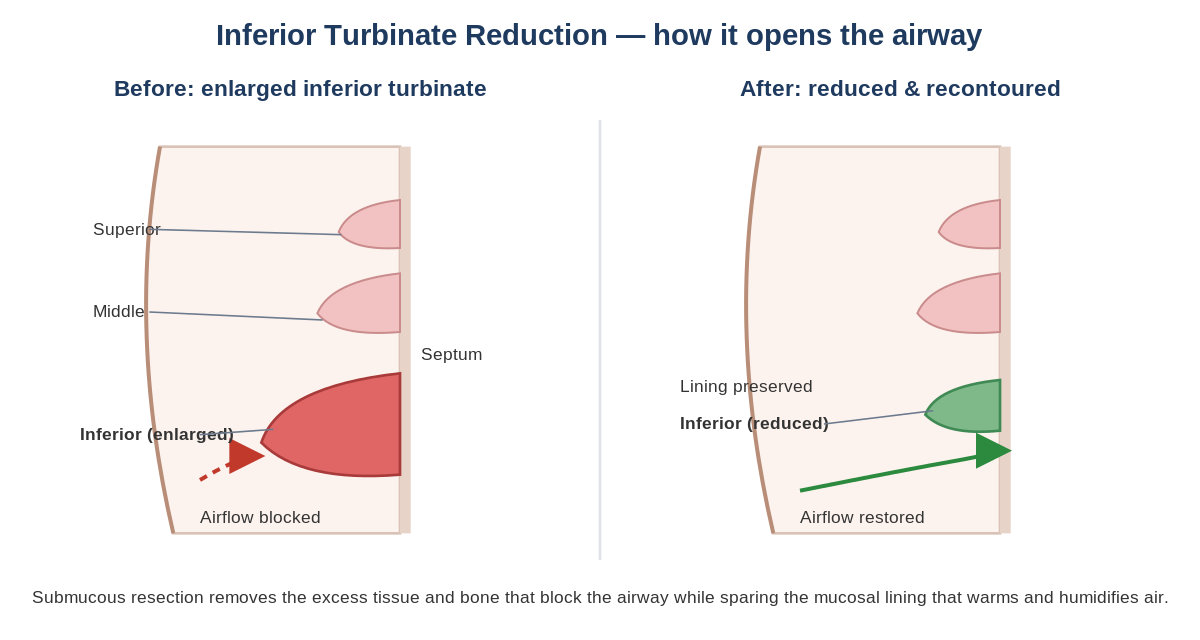
Overview of Inferior Turbinate Reduction
The turbinates are curled, shelf-like structures on the side walls of the nasal cavity. The inferior turbinates are the lowest and largest pair, and they sit directly in the path of airflow. Their job is useful, warming, humidifying, and filtering the air you breathe, so the aim of surgery is never to remove them, only to reduce excess tissue.
Turbinate hypertrophy, the permanent enlargement of this tissue, is usually driven by chronic inflammation from allergies, nonallergic (vasomotor) rhinitis, or a deviated septum that makes the turbinate on the opposite side swell to fill the space. Before any surgery, conservative treatment comes first: steroid nasal sprays, antihistamines and allergy control, and saline irrigation. Inferior turbinate reduction is for patients whose nasal blockage persists despite a fair trial of these treatment options.
Who Is a Candidate: Symptoms and Indications
Turbinate reduction may help if enlarged turbinates are the main reason for your symptoms. Common indications include:
- Chronic nasal congestion and nasal obstruction that does not clear with medication, often with persistent mouth breathing
- Snoring and sleep-disordered breathing, including difficulty tolerating CPAP for obstructive sleep apnea
- Recurrent sinus infections and a reduced sense of smell from long-standing blockage
Many patients describe breathing that is worse on one side, worse lying down, or worse at night. A nasal exam confirms whether swollen turbinates, a deviated septum, or another cause is driving the problem, because the turbinates are not always the culprit.
Types of Nasal Turbinate Reduction Procedures
There is more than one way to reduce a turbinate, and the right choice depends on your anatomy:
- Submucosal resection. Working underneath the lining, the surgeon removes the excess tissue and bone causing the obstruction while leaving the healthy surface mucosa intact. This is Dr. Fewins’ preferred technique because it addresses the actual bulk directly.
- Microdebrider-assisted inferior turbinoplasty. A small powered shaver precisely removes a controlled amount of submucosal tissue from the inside and recontours the turbinate to match your anatomy, again sparing the surface lining.
- Radiofrequency turbinate reduction. A minimally invasive option that uses low heat energy to shrink the turbinate. Rather than removing tissue, it relies on scarring and gradual volume reduction over the weeks that follow, so the amount of shrinkage is less predictable and less tailored to the individual. Dr. Fewins favors direct submucous resection because it gives more control and precision over exactly how much tissue is reduced.
- Turbinate outfracture and partial resection. Gently repositioning the turbinate bone outward to widen the airway, sometimes combined with limited removal of excess tissue.
Many surgeons combine techniques. Dr. Fewins matches the method, and the amount of tissue removed, to the specific problem in your nose rather than using one approach for everyone.
Preoperative Evaluation and Preparation
A thorough workup makes the procedure safer and the result better. Preparation typically includes:
- A complete nasal examination and, when needed, nasal endoscopy to see the turbinates, septum, and nasal passages directly
- A review of your medications, with specific guidance on blood thinners and other anticoagulants, which may need to be paused before surgery
- Guidance on stopping or continuing nasal steroid sprays or decongestants, per Dr. Fewins’ instructions
- Optimizing allergy control beforehand, since well-managed allergies protect your result and reduce the chance the turbinate tissue swells again
What to Expect During Turbinate Reduction Surgery
Turbinate reduction can be done two ways. Many patients are candidates for an office procedure under local anesthesia, sometimes with light sedation. When the work is more extensive or combined with other surgery, it is done in the operating room under sedation or general anesthesia.
The procedure itself is usually brief. All of the work is done inside the nose through the nostril, so there are no external incisions and nothing that changes the outside of your nose. If a deviated septum or sinus disease is also contributing to your blockage, Dr. Fewins may perform a septoplasty or a sinus procedure at the same time, so one recovery treats everything blocking you rather than sending you back for a second operation.
Radiofrequency Turbinate Reduction: Procedure Details
Radiofrequency turbinate reduction is one of the most common in-office techniques, and it is worth understanding how it works. After the inside of the nose is numbed with a topical anesthetic and a small local injection, a fine needle electrode is inserted into the submucosal tissue of the inferior turbinate. Low-power radiofrequency energy is delivered to create a small, controlled lesion beneath the surface, placed along the length of the turbinate. Over the next several weeks the treated tissue shrinks and scars down as it heals, widening the nasal airway while the surface lining is preserved.
Radiofrequency is genuinely minimally invasive and convenient, but it has real trade-offs. Because it works by scarring and gradual volume reduction rather than removing the excess tissue, the result is less predictable and less individualized, and it tends to involve more nasal crusting and a longer healing process. Dr. Fewins performs a submucous resection with a small powered shaver instead, removing a precise, controlled amount of tissue directly. That gives better control and precision, less post-operative care, and a more predictable result matched to your anatomy.
Aftercare and Recovery From Inferior Turbinate Reduction
Recovery is usually straightforward. After an office procedure you are monitored briefly and discharged the same day once you are comfortable and any minor bleeding has settled. Typical aftercare:
- Begin nasal saline irrigation as directed, usually several times a day, to keep the healing tissue clean and moist
- Keep activity light for the first few days and avoid heavy lifting or strenuous exercise; most patients return to work within a day or two after an in-office procedure, longer if surgery was combined with other work
- Expect some nasal crusting and congestion during the first week or two as the turbinates heal, with breathing that improves progressively as the internal swelling goes down
Because no tissue is packed and the lining is preserved, discomfort is usually mild.
Managing Pain and Nasal Congestion After Surgery
Most patients need very little pain medication. For comfort:
- Acetaminophen usually controls the mild soreness; take any prescribed analgesics only as directed
- Use saline sprays and a humidifier to ease dryness and congestion while the lining heals
- Avoid blowing your nose for about two weeks so the healing tissue and small blood vessels are not disturbed
- Call the office for heavy or persistent bleeding, increasing pain, fever, or thick discolored discharge, which can signal a problem
Some congestion during the first week is normal and expected as the tissue settles, not a sign that the procedure did not work.
Expected Outcomes and Turbinate Reduction Change
Breathing often starts to improve within the first week or two, and continues to open up over the following weeks as the turbinates heal and shrink. For appropriately selected patients, the change is durable because the excess tissue is reduced rather than only temporarily decongested. It is normal for internal swelling to narrow your breathing for the first two to four weeks before it steadily opens up, and light nasal crusting can linger for up to three weeks as the lining heals.
A turbinate reduction change is internal only; it reduces tissue inside the nose and does not alter the shape or appearance of your external nose. Many patients also notice less snoring and better sleep quality once the nasal airway is open. Realistically, if allergies or a deviated septum are also part of the picture, you may still need ongoing allergy treatment or an additional procedure for the best long-term result, which Dr. Fewins will discuss with you honestly.
Risks and Complications of Nasal Turbinate Reduction
Turbinate reduction is a low-risk procedure, but no surgery is risk-free. Most issues are minor and temporary:
- Minor bleeding, nasal crusting, and temporary congestion during healing
- Less commonly, persistent obstruction that needs further treatment, or infection
The most important risk to understand is empty nose syndrome. Empty nose syndrome is a rare condition that can follow surgery in which too much turbinate tissue was removed, historically from aggressive operations that took out all or most of the turbinate, including its functional lining. Tissue-preserving techniques, which reduce the turbinate from underneath while keeping the mucosal lining and ample healthy turbinate in place, are exactly what the field recommends to keep that risk very low. If symptoms ever persist or recur, the indications for revision surgery are reviewed carefully rather than reflexively.
When to Contact Our Clinic After Surgery
Call our office right away if you have:
- Uncontrolled bleeding that does not stop with gentle pressure, or any difficulty breathing
- A fever, or worsening facial pain or pressure
- Severe pain that is not relieved by your medication
For a severe or emergency problem, such as heavy bleeding you cannot control or true trouble breathing, seek emergency care and then notify our team.
Frequently Asked Questions About Inferior Turbinate Reduction
Does turbinate reduction change the appearance of my nose?
No. Turbinate reduction is done entirely inside the nose and reduces internal tissue only. It does not change the shape or appearance of your external nose.
What is the typical recovery time and when can I return to work?
After an in-office turbinate reduction, most patients return to work within a day or two and resume normal activity within about a week, with some crusting and congestion as the turbinates heal. Recovery takes longer if the procedure is combined with septoplasty or sinus surgery.
When is turbinate reduction combined with septoplasty?
When a deviated septum is also contributing to your nasal obstruction. Treating the septum and the turbinates together in one setting often gives a better, more durable result than reducing the turbinates alone, and it means a single recovery.
How does radiofrequency turbinate reduction differ from other techniques?
Radiofrequency reduction uses low heat energy to shrink the turbinate by scarring it down gradually over several weeks, so the amount of volume reduction is less predictable and often comes with more crusting and a longer healing process. Dr. Fewins instead removes a precise, controlled amount of tissue with a submucous resection, which gives better control, more predictable results tailored to your anatomy, and less post-operative care.
Could turbinate reduction cause empty nose syndrome?
Empty nose syndrome is a rare complication linked to over-resection, removing too much turbinate tissue. Dr. Fewins uses tissue-preserving techniques that reduce the turbinate while keeping the working lining in place, which keeps that risk very low.
Is turbinate reduction covered by insurance?
Turbinate reduction for chronic nasal obstruction is covered by Medicare and most insurance plans when medical criteria are met, generally including symptoms that persist despite a trial of medical treatment. Our office can help verify your benefits before scheduling.
Why Choose Expert ENT Care for Turbinate Reduction
- Board-certified ENT surgeon. Dr. John L. Fewins brings 25 years of experience focused on the nose and sinuses.
- Care for the whole family. Expert ENT Care offers bilingual care and treats both pediatric and adult patients.
- Office and operating room capability. Procedures can be done in the clinic under local anesthesia or in the OR when combined with other work, matched to what your anatomy needs.
- Personalized care at both locations. You get an honest evaluation and consistent follow-up at our Fort Worth and Cleburne offices, with treatment matched to you rather than a one-size approach.
Book an Evaluation for Chronic Nasal Congestion
If chronic nasal congestion has worn out your patience and your sprays, find out whether turbinate reduction is the right fix. Call to schedule an evaluation at our Fort Worth or Cleburne office.
Call (817) 335-0368 to schedule.
When you call, our team can verify your insurance and any referral requirements, and it helps to have a short history of your nasal symptoms ready so we can make the most of your visit.
Medically reviewed by John L. Fewins, MD, FACS.