Procedure — Nose & Sinus
Septoplasty
Septoplasty straightens a deviated nasal septum when it contributes to blocked breathing. A crooked septum is a finding—not automatic proof that it is the reason you cannot breathe well—so the evaluation also looks at the turbinates, nasal valves and inflammation before deciding what should be treated.
Septoplasty — the short version
- What it does
- Straightens a deviated septum to improve airflow through the nose.
- Who may benefit
- Patients with structural obstruction confirmed on exam — not just a crooked-looking nose.
- What it will not fix
- Allergy symptoms, or chronic sinus infections caused by inflammation alone.
- Typical recovery
- Most patients return to desk work within a few days; full internal healing continues over roughly three months.
What a deviated septum is, and isn't
The nasal septum is the wall of bone and cartilage that divides the inside of your nose into two passages. Almost everyone's septum sits a little off center — that alone isn't a diagnosis. A deviated septum becomes a clinical problem when it's bent or buckled enough to meaningfully narrow one nasal passage and reduce airflow, or when a septal spur (a sharp bony or cartilaginous projection) presses against the wall of the nose.
Most deviations come from one of two sources: cartilage that simply grew off center, or a prior nose injury — sports, a fall, an accident — sometimes years earlier. Symptoms typically include nasal obstruction that's often worse on one side, congestion that doesn't fully clear with sprays, noisy or blocked breathing at night, frequent nosebleeds on the dry side, and in some patients facial pressure or headaches from the deviation contacting a turbinate.
Here is the part that matters most for deciding whether surgery is the right answer: deviated-septum symptoms overlap heavily with allergies and chronic sinusitis. Allergic congestion tends to affect both sides and comes and goes; a structural deviation tends to stay on the same side and doesn't respond to allergy medicine. Both can be present in the same patient at once — which is exactly why an exam, not a mirror, is what tells you which one you have.
What septoplasty can — and can't — fix
Septoplasty is a functional procedure. The reason to do it is breathing, not appearance, and it only helps when a structural deviation is the source of the obstruction.
May help
- Confirmed structural obstruction from a deviated septum, seen on exam or endoscopy
- Breathing difficulty on one or both sides that hasn't improved with medical treatment
- Recurrent nosebleeds or sinus infections tied to the deviated segment
- Facial pain or headaches from septal contact with a turbinate (selected patients)
Won't fix or isn't necessary
- Seasonal or year-round allergy symptoms with no structural blockage on exam
- Cosmetic appearance of the nose alone, with no functional obstruction
- Chronic inflammation or sinus disease that hasn't first been tried on medical management
- Mild deviation with minimal symptoms — not every crooked septum needs correcting
Septoplasty may be combined with turbinate reduction or endoscopic sinus surgery when those conditions also need treatment. It is intended to improve function, not reshape the external nose. An unintended change in appearance is a possible risk. Cosmetic reshaping is a separate discussion.
A dramatic-looking deviation is not always the one causing your symptoms—and a subtle one sometimes is. The important question is whether the anatomy, the examination and what you feel all point to the same source of obstruction.
Dr. John Fewins
NOSE Score — Nasal Obstruction Symptom Evaluation
The NOSE scale gives nasal obstruction a consistent 0–100 score that can be compared over time. Answer all five questions based on the past month. The score describes symptom burden; it does not identify the cause or determine whether septoplasty is appropriate.
The operation
Small, limited deviations and septal spurs can sometimes be corrected in the office under local anesthesia. More complex deviations are done in the operating room under sedation or general anesthesia, which is where Dr. Fewins handles most full septoplasties. A straightforward septoplasty typically takes about 30 minutes; combined procedures — with turbinate reduction or sinus surgery — take longer.
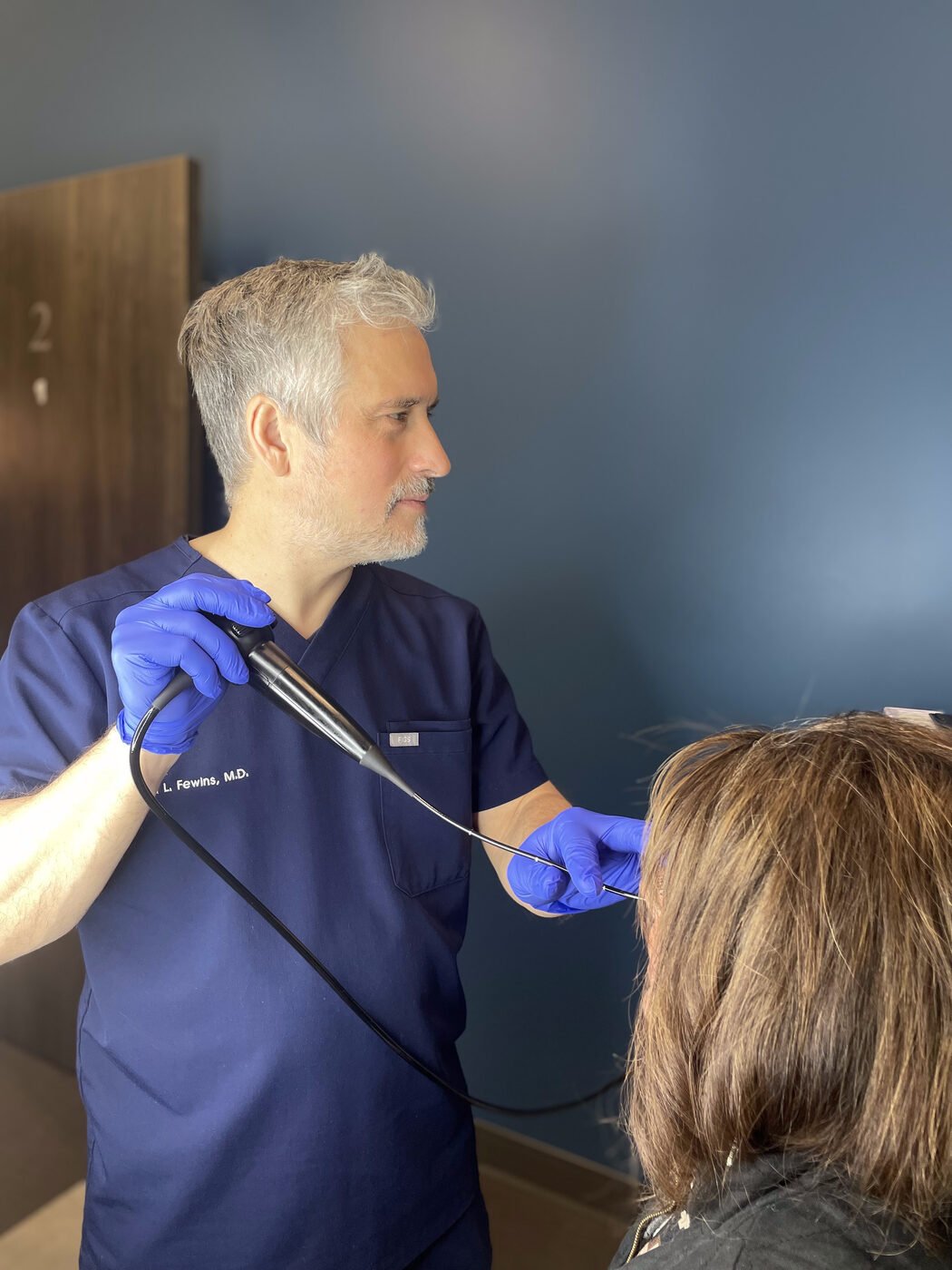
Most septoplasties are done entirely through the nostrils, with no external incision, using either direct visualization or an endoscope for a clear, magnified view of the posterior septum. An open (external) approach, through a small incision at the base of the nose, is reserved for complex deformities or when septoplasty is combined with rhinoplasty. Dr. Fewins uses both endoscopic and open techniques and matches the approach to the anatomy, not to a one-size-fits-all script.
The reshaping itself is conservative by design: deviated cartilage is scored, trimmed, or repositioned, and deviated bone is removed, while a strong, straight framework — the keystone area and an adequate dorsal and caudal strut — is always preserved to keep the nose supported. Occasionally a piece of septal cartilage is used as a graft where extra support is needed. For most operating-room septoplasties, soft internal splints are placed for about three days; they align the septum, reduce swelling, and give more reproducible outcomes. Splints are often left out when septoplasty is combined with sinus surgery. There's usually no old-fashioned nasal packing.
Recovery
-
First several days
Congestion, some bloody drainage, and a stuffy, blocked feeling are normal while internal swelling settles. Splints, if placed, typically come out around day three.
-
Early weeks
Most patients return to desk work within a few days. Avoid forceful nose-blowing, heavy lifting, and contact sports for about two weeks; sneeze with your mouth open.
-
Longer term
Breathing continues to improve as deep swelling resolves, with the final result typically clear within about three months.
For a comfortable recovery: use saline spray or rinses as directed, control discomfort with the medication provided and avoid aspirin/NSAIDs unless cleared, and keep your head elevated the first few nights.
Risks & alternatives
Risks include bleeding, infection, persistent obstruction and a septal perforation—a hole in the dividing wall. A perforation may cause no symptoms, or may lead to crusting, bleeding or whistling. Less common risks include a change in the nose’s appearance or numbness. Your anatomy and prior surgery influence the discussion.
Call the office promptly for heavy or persistent bleeding that doesn't slow with gentle pressure, fever or spreading redness, or symptoms that worsen rather than improve after the first week or two.
Alternatives to surgery: when obstruction is mild, or when allergy or inflammation is doing most of the work, nasal steroid sprays and allergy management come first — septoplasty is for obstruction that hasn't responded to that medical treatment. Balloon dilation is not an alternative for a deviated septum specifically; it opens sinus drainage pathways, not septal cartilage and bone.
Pediatric considerations
In children, timing matters because the nose and midface are still growing. Elective septoplasty is usually deferred until growth is largely complete, generally the mid-to-late teens, unless a significant functional problem — such as marked obstruction after trauma — clearly warrants earlier surgery. When surgery is needed in a younger child, it's kept as conservative as possible to protect ongoing growth. Dr. Fewins counsels families on whether to treat now or wait, based on the individual child rather than a rigid age cutoff.
Frequently asked questions
How long is recovery, and when can I go back to work?
Most patients return to desk work within a few days. Expect congestion for the first one to two weeks while internal swelling settles, and avoid strenuous activity, heavy lifting, and contact sports for about two weeks. Full internal healing continues over roughly three months.
Will it hurt, and what kind of anesthesia is used?
Most patients describe pressure and congestion rather than sharp pain. Small deviations and septal spurs can sometimes be corrected in the office under local anesthesia; more complex deviations are done in the operating room under sedation or general anesthesia.
Does a balloon fix a deviated septum?
No. Balloon dilation is designed to open sinus drainage pathways, not to correct structural cartilage and bone. A deviated septum is a fixed structural problem that requires septoplasty, not a balloon.
Is septoplasty covered by insurance?
When a deviated septum is causing documented nasal obstruction that hasn't responded to medical treatment, septoplasty is typically covered, including by Medicare. Many plans require prior authorization — our team documents your symptoms, exam, and prior treatment and verifies benefits before scheduling. A purely cosmetic rhinoplasty done at the same time is a separate, non-covered cost.
Will septoplasty change how my nose looks?
Septoplasty is intended to improve internal airflow and usually does not visibly change the nose. An unintended appearance change is a possible complication. Discuss any cosmetic goals separately before surgery.