
When your voice changes
A voice that feels strained, breathy, rough or unsteady can affect work and everyday conversation. You may lose volume, tire after talking, struggle with pitch, or hear breaks that are difficult to control. These details help Dr. Fewins decide what to examine and which speaking tasks to assess.
His experience and training in voice disorders support care for subtle vocal-fold lesions, movement disorders and problems with vocal-fold closure. In-office video stroboscopy, laryngeal Botox and injection laryngoplasty are part of the practice’s voice-care capabilities.
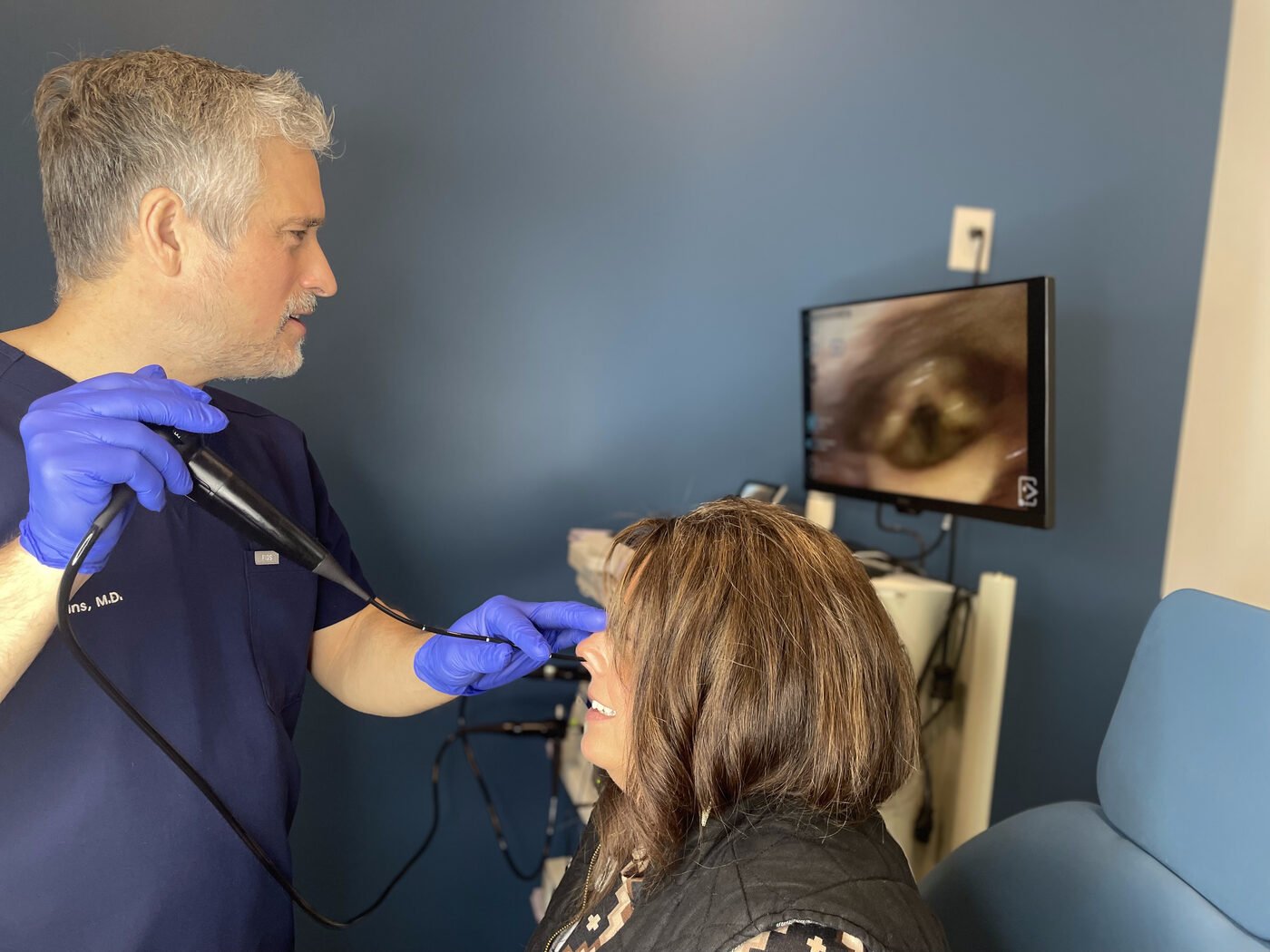
Video stroboscopy: seeing how your voice works
Your vocal folds vibrate too quickly for their fine movement to be assessed with ordinary light alone. Video stroboscopy synchronizes a flashing light with your voice to produce an apparent slow-motion view. This reveals details of vibration that a standard examination may not show.
Flexible laryngoscopy shows the voice box, its structure and overall movement. Stroboscopy adds information about how the vocal-fold surface vibrates; it can use either a flexible scope through the nose or a rigid scope through the mouth. These are complementary parts of an evaluation, rather than simply two different types of scope.
- The mucosal wave: how the pliable surface of each vocal fold moves, including areas of reduced wave or stiffness.
- Symmetry and regularity: whether both sides vibrate together and how consistent the pattern is.
- Closure: whether the folds meet effectively or leave a gap during sound production.
- Small lesions: how a subtle change along the edge affects vibration and the surrounding tissue.
Dr. Fewins uses video stroboscopy in most voice-disorder evaluations when appropriate. It helps him distinguish findings that may look similar under ordinary light and explain why a particular treatment fits your voice problem. Interpretation combines the images, the sound of your voice and your history. Very irregular vibration can limit the stroboscopic view.
Small lesions can have a large effect
A nodule, polyp, cyst or area of scar can change how a vocal fold vibrates. Size alone does not explain how much it affects your voice. A small stiff area can interfere with the surrounding wave, and a lesion can change how the two sides close.
The examination helps guide a discussion of voice therapy, changes in vocal use, medical treatment or a procedure. A concerning lesion may need biopsy; stroboscopy adds useful detail but cannot replace tissue diagnosis when that is necessary.
Botox for laryngeal dystonia and vocal tremor
Spasmodic dysphonia, also called laryngeal dystonia, causes involuntary muscle activity that interrupts the voice. Vocal tremor can create rhythmic shaking and may occur with or separately from dystonia. The patterns can resemble other voice problems, so diagnosis comes before choosing an injection.
Dr. Fewins performs targeted botulinum toxin (Botox) injections for laryngeal dystonia, including spasmodic dysphonia, and selected vocal tremor. The goal is to reduce unwanted muscle activity and make speaking easier. The injection plan is individualized to the movement pattern and response to prior treatment.
Benefits are temporary, and repeat treatment is often needed. A temporarily breathy or weak voice and difficulty swallowing, particularly liquids, can occur. The expected benefit, treatment interval and trade-offs vary; follow-up helps refine the plan.
Muscle tension dysphonia needs its own approach
Muscle tension dysphonia (MTD) involves excessive effort or tension during voice production. It can be a primary problem or a response to another issue, such as incomplete vocal-fold closure. It is different from laryngeal dystonia, although the symptoms can overlap.
Voice therapy is generally the starting treatment. Dr. Fewins also offers Botox for selected persistent MTD when evaluation supports it and an appropriate course of therapy has not provided enough improvement. If tension is compensating for a closure gap, treating that underlying gap may be more useful than simply reducing muscle activity.
In-office injection laryngoplasty
A weak, breathy voice can result when the vocal folds do not meet well. Vocal-fold weakness, paralysis or loss of tissue bulk can leave an air gap that makes speaking require more effort.
Dr. Fewins performs injection laryngoplasty in the office for appropriate patients. An injectable material adds bulk to improve closure. This is a different treatment from Botox: augmentation supports closure, while Botox reduces selected muscle activity.
An office procedure may avoid general anesthesia. The choice depends on your anatomy, diagnosis and ability to tolerate the examination. Material choice, expected duration and follow-up are discussed before treatment. Risks include bleeding, swelling, an unsatisfactory voice result and, rarely, breathing problems; some patients need repeat treatment or another approach.
Care for the voice you rely on
Teachers, singers, clergy, speakers and people who spend the day on calls may notice changes that are easy to miss in a short conversation. Tell us about lost range, reduced endurance and the demands of your work. The goal is to understand the specific function you want back.
Bring prior examination reports, recordings if you have them, and a list of previous treatments. Dr. Fewins explains what the examination shows and how therapy or a procedure relates to those findings. Follow-up can assess changes in both vocal function and the examination.
Throat and swallowing symptoms
Persistent throat discomfort, frequent clearing, a lump sensation or difficulty swallowing also deserve evaluation. Reflux is one possible contributor, but these symptoms have several causes. An examination helps determine whether additional swallowing testing, medical treatment or another specialist’s input is useful.
Seek prompt assessment for worsening swallowing difficulty, coughing with meals, a neck lump or unexplained weight loss. Breathing difficulty or inability to swallow saliva requires urgent care. Hoarseness that is not improving should be evaluated, especially with tobacco exposure or other concerning symptoms.
Common questions
Is video stroboscopy the same as flexible laryngoscopy?
They overlap, but describe different aspects of the examination. Flexible laryngoscopy uses a scope passed through the nose. Stroboscopy adds synchronized light to assess vocal-fold vibration and may use a flexible or rigid scope.
Does every voice problem need Botox?
No. Botox is useful for particular muscle-activity disorders. Voice therapy, treatment of a lesion or correction of a closure gap may be more appropriate for another diagnosis.
Can vocal-fold injections be performed in the office?
Yes. Dr. Fewins performs in-office injection laryngoplasty in suitable patients. The examination and discussion determine whether an office procedure is appropriate for you.
Is Botox a routine first treatment for muscle tension dysphonia?
No. Voice therapy is generally the initial approach. Botox is reserved for selected persistent cases after careful evaluation.