
If chronic sinus infections, sinus pressure, and congestion keep running your life — and antibiotics only help for a while — balloon sinuplasty may offer lasting relief without traditional sinus surgery. For patients suffering from ongoing sinusitis symptoms, it’s a minimally invasive way to reopen a blocked sinus passage and restore drainage from the sinus cavity: no cutting, no removal of bone or tissue, and most patients back to normal activities in just a day or two.
At Expert ENT Care in Fort Worth, Dr. John L. Fewins, MD, FACS — a board-certified otolaryngologist with 25 years of experience and thousands of sinus procedures — performs balloon sinuplasty both in the office under local anesthesia and in the operating room. Just as importantly, he’ll tell you plainly when a balloon isn’t the right answer and something more thorough is. He sees patients in Fort Worth and Cleburne, and cares for Spanish-speaking patients directly, in fluent Spanish.
What is balloon sinuplasty?
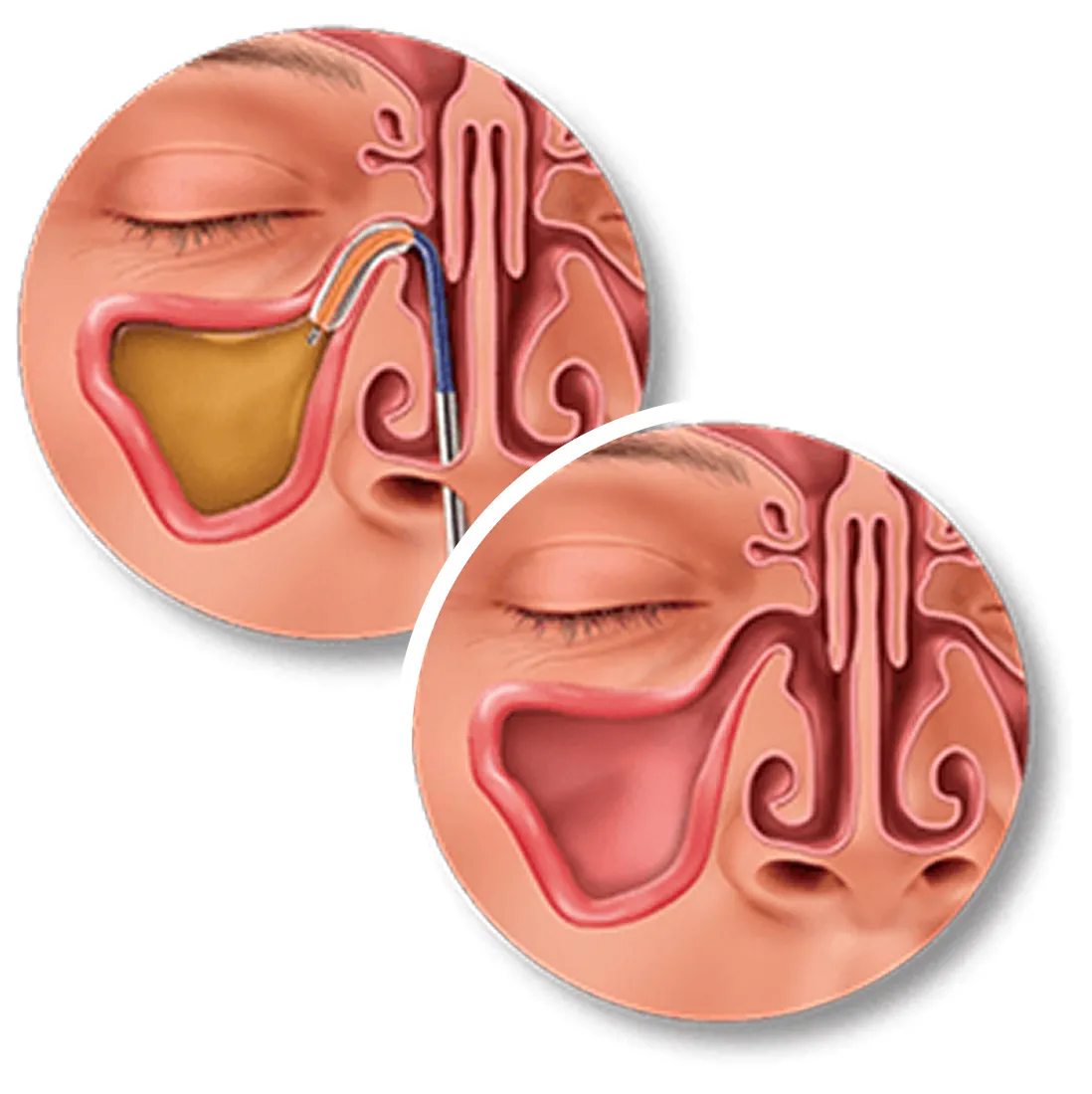
Balloon sinuplasty (also called balloon catheter sinusotomy or balloon dilation) is a minimally invasive procedure that reopens a blocked sinus by gently widening its natural drainage opening — the sinus ostium — with a small, flexible balloon catheter. The primary goal is simple: restore normal sinus drainage so mucus and infection stop backing up.
Because it doesn’t involve cutting and no tissue is removed, it’s far less invasive than traditional surgery. Balloon sinuplasty is typically performed in the doctor’s office under a local anesthetic, or in a hospital operating room under sedation or general anesthesia when a case calls for it. It has been FDA-cleared since 2005 and used in hundreds of thousands of patients.
How balloon sinuplasty works
The procedure is done entirely through the nostril, with no incisions on your face, and a small balloon does the gentle work. Step by step:
- Using a nasal endoscope for a clear view, a thin guide catheter is passed to the opening of the blocked sinus.
- A flexible balloon catheter is advanced and positioned across the narrowed sinus opening.
- The tiny balloon is slowly inflated to dilate the sinus ostium and open the sinus cavity, gently restructuring the drainage pathway.
- The sinus is irrigated to flush out trapped mucus and debris, then the balloon and instruments are withdrawn.
Is balloon sinuplasty right for you — and when it isn’t
This is the part most websites skip, and it’s the part that matters most. Balloon sinuplasty is the most heavily marketed sinus procedure in the country, and it is not the right answer for everyone who’s told they need it.
I’ve done thousands of these over more than twenty years, so let me be straight with you: balloon sinuplasty is done more often than it should be. It genuinely helps the right patient — it reopens natural drainage and can spare you a bigger operation. But when the real problem is deeper disease or nasal polyps, a balloon alone won’t fix it. I regularly see those patients later for a second opinion, after a balloon that never worked because the underlying problem was never addressed. I only recommend it when it’s truly the right operation for you — and when you need something more thorough, I’ll tell you, and I’ll do that instead. The recommendation I make for you is the one I’d make for my own family.
— Dr. John Fewins
- A shadow on a CT scan is not, by itself, a reason to operate. Many people with no sinus symptoms have “abnormal-looking” sinuses on a scan, and a simple cold can make one look dramatic for weeks. Dr. Fewins reviews your CT scan with you and helps you understand what it shows and what he recommends. Your scan is also read by an independent, board-certified radiologist — a second, unbiased set of eyes — so nothing is missed and the recommendation is never based on a single in-office interpretation.
- Some patients do better with a different fix. Chronic drainage can come from allergies, a deviated septum, swollen turbinates, or an overactive nasal nerve — each with its own, better-matched treatment.
- Some patients need more, not less. Extensive ethmoid disease, nasal polyps, or fungal sinusitis usually need functional endoscopic sinus surgery, not a balloon. Done alone on the wrong patient, a balloon fails — and you’re back where you started.
None of this is a reason to avoid balloon sinuplasty. It’s a reason to have your case looked at by someone who weighs the whole picture and recommends what’s genuinely best for you.
Already had a balloon sinuplasty that didn’t work? A thorough second opinion can find what was missed and identify the treatment that will actually last.
Could balloon sinuplasty be right for you?
Balloon sinuplasty gently reopens blocked sinuses — no cutting, no removal of bone or tissue. Check any of these that sound like you:
This tool is for general education only and does not provide a diagnosis or replace a medical evaluation.
Based on your symptoms, you could be an excellent candidate for balloon sinuplasty.
The symptoms you selected are exactly the kind balloon sinuplasty is designed to relieve. Many people with these symptoms get lasting relief from a quick procedure — often done right in the office, with most patients back to normal activities within a day or two.
The next step is a simple evaluation to confirm it’s the right fit. Dr. Fewins will look at your individual case and recommend the treatment that’s genuinely best for you — the same recommendation he’d give a member of his own family.
Call (817) 335-0368 to scheduleTell us what’s bothering you.
You didn’t select any symptoms — which is good news. If sinus pressure, congestion, drainage, or recurring infections do start to bother you, balloon sinuplasty is one of the gentlest ways to get lasting relief, and an evaluation is the place to start.
Whenever you come in, Dr. Fewins will recommend the treatment that’s genuinely best for you — the same recommendation he’d give a member of his own family.
Call (817) 335-0368 with questionsIn-office versus operating room
Balloon sinuplasty can be done two ways, and Dr. Fewins matches the setting to your anatomy and your comfort:
- In the doctor’s office, under a local anesthetic. Balloon sinuplasty in the office typically takes about 30 minutes, costs less, avoids the operating table and general anesthesia, and lets you drive yourself home — ideal for straightforward, limited disease. Many patients are back to their routine in just a day.
- In the operating room, under conscious sedation or general anesthesia. The better choice when several sinuses are involved, when your anatomy is complex, or when balloon dilation is combined with another procedure (a hybrid approach). Recovery is still short.
Balloon sinuplasty versus endoscopic sinus surgery
Functional endoscopic sinus surgery (FESS) is the traditional operation for chronic sinusitis. Using an endoscope, the surgeon opens and clears diseased sinuses — and, unlike a balloon, can remove polyps, inflamed tissue, and bone when the disease requires it. Balloon sinuplasty is less invasive: it dilates the natural sinus opening without cutting, so there’s generally less pain, less bleeding, and a faster return to normal activities.
The honest distinction is this: a balloon is excellent at reopening a blocked drainage pathway, but it does not address disease inside the sinus. So:
- Balloon sinuplasty may be favored for limited chronic sinusitis or recurrent acute rhinosinusitis where the main issue is a narrowed sinus opening, medications haven’t worked, and there are no polyps.
- Endoscopic sinus surgery is the better choice when there are nasal polyps, extensive ethmoid disease, fungal sinusitis, or significant structural disease a balloon can’t reach.
- A hybrid approach — balloon dilation of some sinuses plus targeted endoscopic surgery of others — is sometimes the most efficient, least invasive way to treat everything that’s actually diseased in one setting.
Choosing correctly among these sinus surgery options is exactly where an experienced, honest evaluation earns its keep.
Who is a candidate? Indications and selection
You may be a candidate for balloon sinuplasty if you have:
- Chronic rhinosinusitis (CRS) that hasn’t improved despite appropriate medical therapy — sprays, rinses, and antibiotics;
- Recurrent acute rhinosinusitis — four or more sinus infections a year;
- CT evidence of a blocked or narrowed sinus opening that matches your symptoms and exam.
That last point is non-negotiable here: Dr. Fewins recommends the procedure only when your symptoms, your nasal endoscopy, and your CT scan all point to the same problem. Imaging alone is never enough.
Contraindications and limitations
Balloon sinuplasty is not appropriate for everyone. It is generally the wrong tool — or not enough on its own — when there is:
- Chronic rhinosinusitis with nasal polyps (CRSwNP), which usually needs endoscopic surgery to remove the polyps;
- Cystic fibrosis or extensive, multicellular ethmoid disease a balloon can’t clear;
- Fungal sinusitis or significant structural problems that require formal surgery.
Any prior sinus surgery or skull-base issues are reviewed carefully before anything is scheduled. Recognizing these limitations up front is how you avoid a procedure that was never going to work.
Preparing for the procedure
Preparation is straightforward. Beforehand, Dr. Fewins obtains a sinus CT scan and notes your baseline symptoms so results can be measured against a real starting point. On the day of an in-office procedure, your nose is prepared with a topical decongestant and numbed with topical and local anesthesia so you stay comfortable. You’ll get simple instructions about which medications to pause and, for cases done under sedation or general anesthesia, about fasting. The equipment is minimal — a nasal endoscope and an FDA-cleared balloon system — and the procedure is done with a trained clinical team.
How Dr. Fewins tailors the procedure
There’s no single “balloon” and no single right setting. Dr. Fewins selects among several balloon systems — including Acclarent, Medtronic, and VenSure — based on your specific sinus anatomy, whether the frontal, maxillary, or sphenoid sinuses are involved, and decides with you whether the office or the operating room is the safer, more thorough choice. Matching the tool and the setting to your anatomy is part of doing the procedure well.
Recovery time and what to expect
Recovery from balloon sinuplasty is short. Most patients return to normal activities within 24 to 48 hours. In the first 24 to 72 hours it’s normal to have mild congestion, tenderness, and a little bloody drainage as the sinuses settle — there’s no nasal packing and typically no bruising. Full recovery is usually quick, with most patients fully back to normal within a week or two.
- Use saline rinses as directed to keep the sinuses clean and comfortable.
- Keep your head elevated the first night and avoid strenuous activity or heavy lifting for about a week.
- Most people return to work within a day or two.
- Plan on a follow-up visit so Dr. Fewins can confirm the sinuses are draining well.
Call the office promptly if you have heavy bleeding, a high fever, severe or worsening pain, vision changes, or persistent clear watery drainage — these are uncommon but worth a same-day call.
Risks, complications, and safety
Balloon sinuplasty has a strong safety record. Most side effects are minor and short-lived: temporary congestion, mild pain or pressure, a small amount of bloody drainage, and short-term tenderness. Serious complications — such as bleeding that needs attention or, very rarely, injury near the eye or skull base — are uncommon, and are minimized by careful patient selection and image guidance. The technology has been FDA-cleared since 2005, and its safety has been supported in multicenter studies.
Does balloon sinuplasty work?
For appropriately selected patients, yes — and the improvement lasts. In multicenter studies, patients treated for chronic sinusitis reported meaningful, durable gains in symptoms and quality of life, with high patient-satisfaction rates and long-term outcome analysis showing benefit maintained at two-year follow-up. Symptom improvement is comparable to traditional sinus surgery for the right, limited disease — with less pain and faster recovery. A clinical consensus statement from the American Academy of Otolaryngology–Head and Neck Surgery supports balloon dilation for appropriately selected patients, and the procedure is now offered by many healthcare providers.
The honest caveat, again: this is true for the right patient. Because a balloon treats a drainage-pathway problem specifically, patient selection is what separates a lasting result from a procedure that disappoints. Individual results vary; Dr. Fewins sets realistic expectations with you after your evaluation.
Frequently asked questions
How quickly will I feel better?
Many patients notice easier breathing and less pressure within the first week, with continued improvement over the following weeks as swelling settles and the sinuses drain.
Is it painful, and what about anesthesia?
Your nose is numbed beforehand, so most patients feel pressure rather than pain. In-office procedures use local anesthesia; operating-room cases use conscious sedation or general anesthesia. Any soreness afterward is usually mild and brief, and controlled with over-the-counter pain medication.
Do I really need it, or is it being over-recommended?
A fair question — and the right one to ask. Dr. Fewins recommends balloon sinuplasty only when your symptoms, exam, and CT scan agree, and he’ll tell you when medication, a different procedure, or more thorough surgery is the better fit.
Is it covered by insurance, and what does it cost?
These procedures are typically covered by insurance, including Medicare, when medical criteria are met. Your out-of-pocket cost depends on your plan and whether the procedure is done in the office or the operating room. Our team will help you navigate your coverage and verify benefits before anything is scheduled.
Is balloon sinuplasty appropriate for children?
Occasionally, in carefully selected cases — and in children it’s performed under general anesthesia, not in the office. Many children with sinus symptoms are better helped by other treatments first. Dr. Fewins, who has decades of pediatric ENT experience, will guide the right approach for a child.
Why choose Expert ENT Care for sinus care in Fort Worth
- Dr. John L. Fewins, MD, FACS — board-certified, 25 years of experience and thousands of sinus procedures, focused on the nose and sinuses.
- A personalized evaluation with real diagnostic testing — nasal endoscopy and a CT scan reviewed with you, and independently read by a radiologist.
- The full range of options — in-office or operating room, balloon, endoscopic surgery, or a hybrid — with the device and setting matched to your anatomy.
- Straight talk: the recommendation you get is the one he’d give his own family, and second opinions after a failed balloon are welcome.
- Convenient care in Fort Worth and Cleburne — and fluent Spanish spoken, so Spanish-speaking patients are cared for directly, not through a translator.
Book a consultation
Find out whether balloon sinuplasty is genuinely the right fix for you — or whether another treatment will do the job — with an honest evaluation at Expert ENT Care in Fort Worth. Our team will verify your insurance benefits before your visit.
Call (817) 335-0368 to schedule.
Medically reviewed by John L. Fewins, MD, FACS.
Clinical data: Weiss RL, Church CA, Kuhn FA, et al. Long-term outcome analysis of balloon catheter sinusotomy (CLEAR study): two-year follow-up. Otolaryngol Head Neck Surg. 2008;139(3 Suppl 3):S38–46; with consistent findings in subsequent long-term outcome studies. See also the AAO-HNS Clinical Consensus Statement on balloon dilation of the sinuses.