
Pediatric ENT
Thoughtful ENT care for your child.
Dr. John Fewins cares for children with recurring ear infections, hearing concerns, enlarged tonsils and adenoids, and nasal problems. He directs your child’s care, explains whether a procedure is useful, and performs the surgery when it is recommended.
A clear plan, with a familiar team
Care starts with the child in front of us: their symptoms, hearing, sleep and development. Dr. Fewins and Jennifer Booker, NP, work as a small, consistent team. Jennifer’s patients are reviewed with him, and he handles complex concerns and surgical decisions.

What we treat
Conditions we treat in children
Ear infections & fluid
Frequent ear infections and persistent middle-ear fluid.
When ear tubes may helpHearing problems
Including fluid or infections that can affect a child's hearing, speech development, and learning.
Hearing testing for childrenEnlarged tonsils & adenoids
Tissue that's grown large enough to affect breathing, sleep, or swallowing.
About tonsils and adenoidsSnoring & sleep-disordered breathing
Loud snoring, pauses in breathing, or restless sleep.
Sleep symptoms and enlarged tonsilsChronic or recurrent sore throats
Repeated strep or throat infections, year after year.
When recurrent infections need evaluationNasal obstruction & congestion
Chronic congestion or a blocked-feeling nose.
Adenoids and nasal breathingOn-site pediatric hearing testing (audiology)
When a child's ears are the concern, hearing is the question that matters — and we can answer it in our office. Our audiology services let us test your child's hearing as part of the same visit when appropriate and scheduling permits, so decisions about ear tubes or ongoing fluid are based on real measurements and a careful evaluation. If your child's hearing is being affected, we find it early and treat the cause.
We provide audiology and treat the ear conditions behind hearing and related speech concerns; we do not offer speech therapy itself. When speech therapy is the right next step, we'll point you to it.
The anesthesia difference
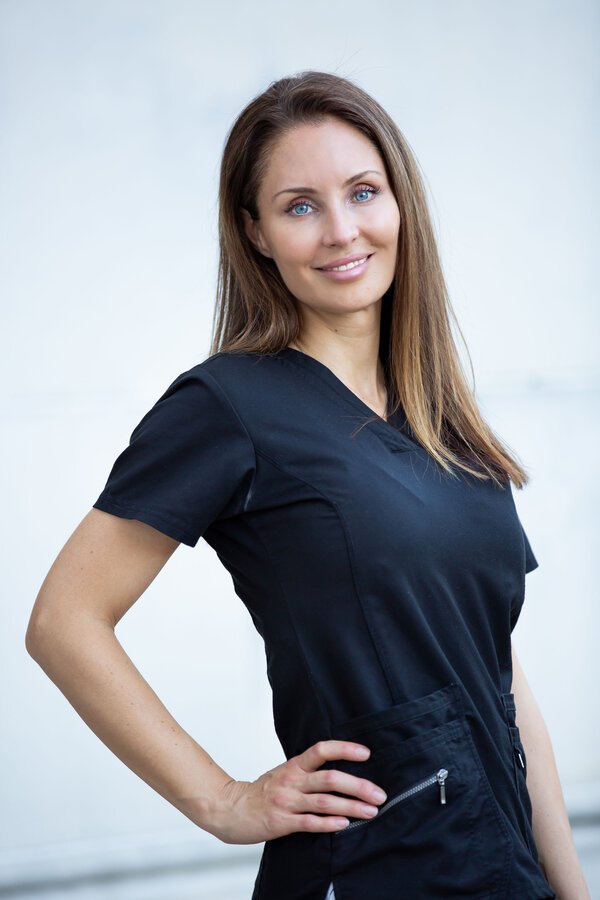
Dr. Ania Gawel, MD — board-certified in Anesthesiology and Pediatric Anesthesiology.
Dedicated pediatric anesthesia care
Many hospitals use an accepted anesthesia care-team model: a certified registered nurse anesthetist (CRNA) remains in the operating room while a physician anesthesiologist may oversee more than one room and is present at key portions of care. Families do not always realize that the physician anesthesiologist may not remain in the room throughout the procedure.
Expert ENT and Sinus Care uses a different model for these pediatric cases. Your child's anesthesia is provided personally by Dr. Ania Gawel, MD, a physician anesthesiologist who is board-certified in both Anesthesiology and Pediatric Anesthesiology. Dr. Gawel alone provides the anesthetic from start to finish and does not simultaneously supervise another operating room.
It is reasonable to ask any surgeon who will personally provide your child's anesthesia and who will remain in the room throughout the operation. In our cases, the answer is Dr. Gawel—from start to finish.
Dr. John Fewins
Meet Dr. Gawel. Dr. Gawel is a highly experienced anesthesiologist who is board-certified in both Anesthesiology and Pediatric Anesthesiology, with fellowship training in pediatric anesthesiology from Cincinnati Children's Hospital. She earned her medical degree from Creighton University School of Medicine and completed her residency at UT Southwestern Medical Center, and has been in clinical practice since 2011. She provides anesthesia care for patients of all ages — from infants and children through adults in their 90s — with particular expertise in pediatric cases. (Full bio on our Meet Our Team page.)
Modern techniques, gentler on your child
Dr. Fewins uses Coblation and thermal welding for appropriate tonsil and adenoid procedures. He chooses the technique around the intended operation and discusses the expected recovery. Read more about tonsil and adenoid surgery.
Choosing the right setting
Many pediatric procedures are performed at a local ambulatory surgery center. Dr. Fewins selects the setting around your child’s health and the planned operation. A hospital may be appropriate when additional resources or monitoring are needed.
The facility charge can differ dramatically between an ambulatory surgery center and a hospital outpatient department. In our practice experience, we commonly see families paying less than half—and sometimes close to one-third—of the hospital outpatient cost for the same planned procedure.
That is an observation from families and estimates we have encountered, not a guarantee or a published average. Your cost depends on the procedure, facility, insurance network, deductible and benefits. Ask for estimates that separately identify surgeon, anesthesia and facility charges. Cost matters, but the safest appropriate setting for your child comes first.
Safe, comfortable care built for children
The plan brings the surgeon, anesthesia provider and recovery team together around your child’s needs.
- Your child's anesthesia is provided personally by Dr. Ania Gawel, MD, a physician anesthesiologist board-certified in both Anesthesiology and Pediatric Anesthesiology.
- The surgery-center team includes staff specifically trained in pediatric care and recovery.
- Careful patient selection. Surgery centers are an excellent, safe option for healthy children who are good candidates. If your child would be safer having their procedure in a hospital, Dr. Fewins will tell you plainly and help arrange it. Your child's safety comes first, always.
Feeding & tongue movement
Tongue-tie: look at function first.
A tight band beneath the tongue does not, by itself, tell us that a child needs a procedure. The question is whether restricted movement is contributing to a specific feeding or speech concern. Dr. Fewins evaluates the tongue’s movement and the problem your family is experiencing before recommending treatment.
Our dedicated page explains when evaluation is useful, how treatment decisions are made, and where feeding or speech support fits.
Tongue-tie evaluation and treatmentPediatric care
Common procedures
Ear Tubes for Children
For children stuck in a cycle of ear infections or lingering fluid affecting hearing.
Learn more →Tonsil & Adenoid Surgery
For heavy snoring, sleep-disordered breathing, or repeated throat infections, using gentler techniques.
Learn more →Tongue-Tie Treatment
Evaluation and treatment for tongue-tie affecting feeding or speech.
Learn more →Why Fort Worth families choose Dr. Fewins
- Extensive pediatric ENT experience, including more than 10,000 tonsillectomies and thousands of ear-tube procedures
- Dr. Fewins directs complex care and surgical decisions, performs every operation, and remains involved through recovery
- On-site pediatric hearing testing (audiology)
- Dr. Ania Gawel, our pediatric anesthesiologist, personally providing anesthesia care
- A lower-cost surgery-center option, with help understanding your estimate
- An independent practice — your family, not a case number
You have more choice than you may be told
Over the past decade, much of the pediatric specialty care in our area has been consolidated into large hospital systems. When care concentrates that way, families are usually referred within a single system — and many parents never learn that an experienced independent specialist is available, or that the very same procedure can cost far less outside a hospital.
Here's what's easy to miss: you can ask about your choice of surgeon and surgical setting. You may have a choice of ENT even when your pediatrician recommends a particular practice or hospital system. Whether a formal referral is required and which facilities are available depend on your insurance plan and your child's clinical needs. Our office can help you verify your coverage. If you would like an experienced, independent pediatric ENT who directs complex care, personally performs every operation and remains involved through recovery, we would be glad to see your child.
Frequently asked questions
When should my child see a pediatric ENT?
Consider an ENT evaluation if your child has frequent ear infections, fluid that won't clear, hearing concerns, heavy snoring or pauses in breathing during sleep, or repeated sore throats — especially when the problem keeps coming back despite treatment from the pediatrician.
Do I need a referral to see Dr. Fewins?
Usually not. Most commercial insurance plans let you see an ENT directly. You may have a choice of ENT even when your pediatrician recommends a particular practice or hospital system. Whether a formal referral is required depends on your insurance plan. Our office can help you verify your coverage.
Will surgery be done in a hospital or a surgery center?
For healthy children who are good candidates, Dr. Fewins performs many procedures at an ambulatory surgery center. In our experience, family estimates can be dramatically lower than hospital outpatient charges, although this varies by procedure and insurance. Children who need hospital resources or monitoring are cared for there—Dr. Fewins will explain which setting fits your child.
Can you test my child's hearing?
Yes. We offer on-site audiology, so hearing can be measured during the same visit when appropriate and scheduling permits, and factored into decisions about ear tubes or persistent fluid.
Who gives my child anesthesia?
Dr. Ania Gawel, MD, a physician anesthesiologist board-certified in both Anesthesiology and Pediatric Anesthesiology, personally provides the anesthetic from start to finish for our pediatric ENT procedures. She is the sole anesthesia professional assigned to the case and does not simultaneously supervise another operating room.
Dr. John L. Fewins, MD, FACS is a board-certified otolaryngologist serving Fort Worth and the surrounding communities. Individual results and recovery vary.