
Procedure — Nose & Sinus
Turbinate Reduction
Turbinate reduction shrinks enlarged inferior turbinates — the shelf-like structures inside the nose that warm, humidify, and filter the air you breathe — when they've grown swollen enough to block airflow. The goal is never to remove them; it's to reduce excess tissue while keeping the working lining intact.
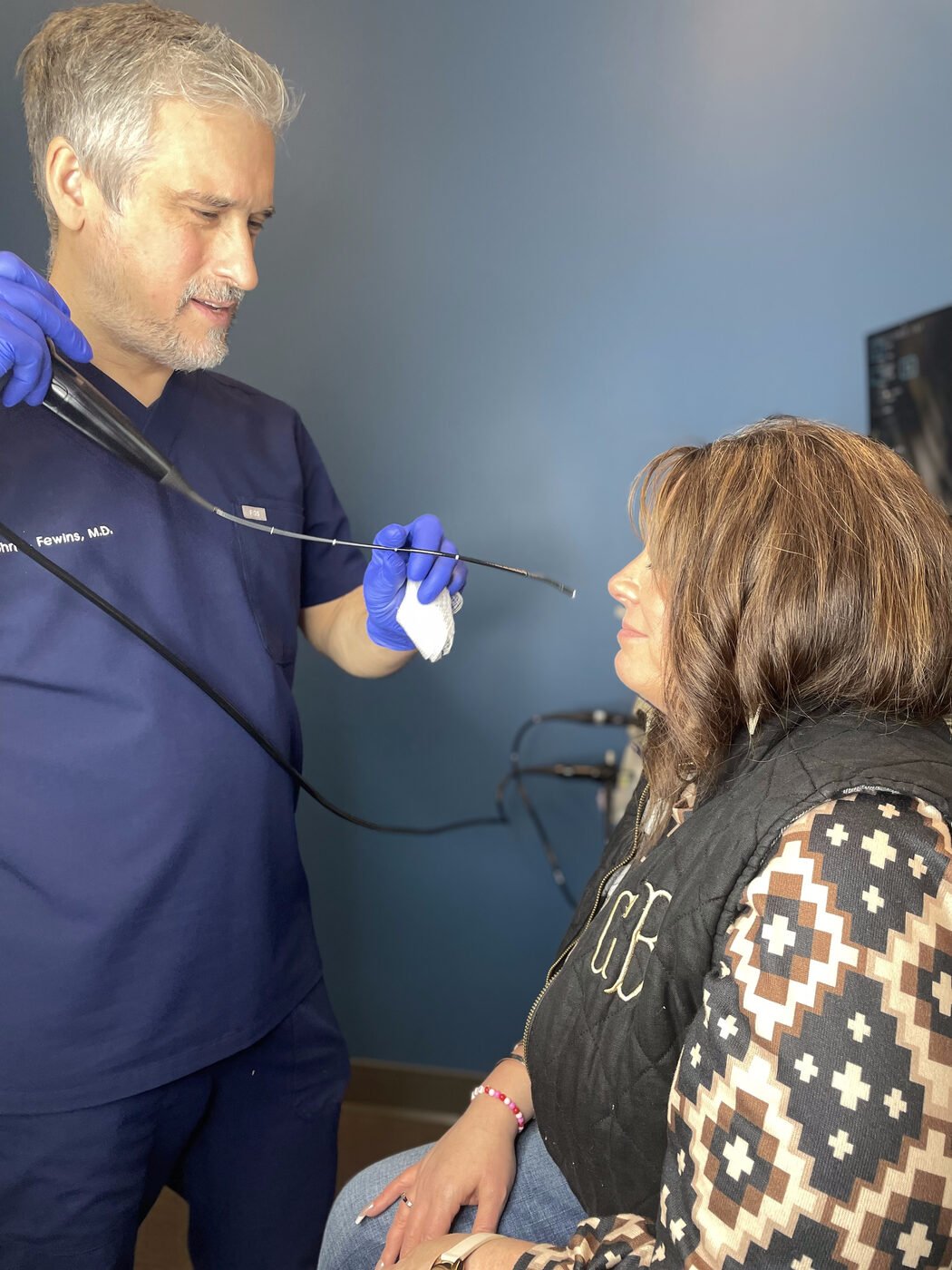
Turbinate reduction — the short version
- What it does
- Reduces enlarged inferior turbinate tissue to open the nasal airway.
- Who may benefit
- Patients with chronic congestion from swollen turbinates confirmed on exam, not resolved by medical treatment.
- What it will not fix
- A deviated septum, or congestion driven purely by uncontrolled allergies.
- Typical recovery
- Most in-office patients return to work within a day or two; full settling takes a few weeks.
Why turbinates become enlarged
The turbinates are curled, shelf-like structures on the side walls of the nasal cavity; the inferior turbinates are the lowest and largest pair, sitting directly in the path of airflow. Their job — warming, humidifying, and filtering the air you breathe — is a real one, which is why surgery aims to reduce excess tissue, never remove the structure.
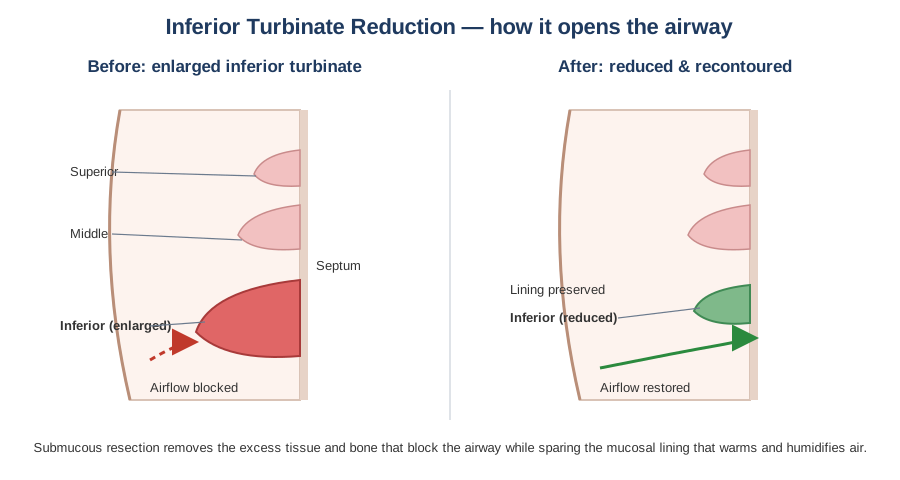
Turbinate hypertrophy — enlargement of this tissue — is usually driven by chronic inflammation from allergies, nonallergic (vasomotor) rhinitis, or a deviated septum that makes the turbinate on the opposite side swell to fill the space it's been given. That last mechanism is the reason these two pages sit next to each other: a septum problem can masquerade as a turbinate problem, and vice versa, and an exam is what tells them apart. Conservative treatment always comes first — steroid nasal sprays, antihistamines and allergy control, and saline irrigation. Turbinate reduction is for congestion that persists despite a fair trial of that treatment.
What turbinate reduction can — and can't — fix
May help
- Chronic nasal congestion and obstruction confirmed on exam that hasn't cleared with medication
- Snoring or sleep-disordered breathing, including difficulty tolerating CPAP
- Recurrent sinus infections or reduced sense of smell tied to long-standing blockage
- Breathing that's worse on one side, worse lying down, or worse at night
Won't fix or isn't necessary
- Obstruction that's coming from a deviated septum, not the turbinates
- Uncontrolled allergies that haven't first been given a real medical trial
- Mild, intermittent congestion that responds adequately to sprays
- Congestion from active sinus infection rather than structural turbinate tissue
Turbinate reduction is frequently combined with septoplasty when a deviated septum shares the blame, or with sinus surgery when chronic sinusitis is also present — one recovery instead of two. It changes tissue inside the nose only; it does not alter the external appearance of your nose.
Techniques
There is more than one way to reduce a turbinate, and the right choice depends on anatomy:
| Technique | How it works | Notes |
|---|---|---|
| Submucosal resection | Removes excess tissue and bone from underneath the lining, leaving the surface mucosa intact. | Dr. Fewins' preferred technique — addresses the actual bulk directly. |
| Microdebrider-assisted turbinoplasty | A small powered shaver precisely removes a controlled amount of submucosal tissue and recontours the turbinate. | Also spares the surface lining; often used by Dr. Fewins for control and precision. |
| Radiofrequency reduction | Low heat energy creates a submucosal lesion; the turbinate shrinks and scars down gradually over several weeks. | The pattern and degree of enlargement influence suitability; further treatment may be needed. |
| Outfracture / partial resection | Gently repositions the turbinate bone outward to widen the airway, sometimes with limited tissue removal. | Often used alongside another technique, not alone. |
Dr. Fewins favors direct submucous resection over radiofrequency because it gives more control and precision over exactly how much tissue is reduced, with a more predictable result matched to the individual anatomy rather than to a fixed protocol.
The operation
Many patients are candidates for an office procedure under local anesthesia, sometimes with light sedation. When the work is more extensive, or combined with septoplasty or sinus surgery, it's done in the operating room under sedation or general anesthesia. All of the work is done inside the nose through the nostril — there are no external incisions and nothing that changes the outside of your nose.
Preparation typically includes a nasal exam and, when needed, endoscopy; a review of blood thinners and other medications; and optimizing allergy control beforehand, since well-managed allergies protect the result and reduce the chance the tissue swells again.
Recovery
-
Same day
After an office procedure, you're monitored briefly and discharged once comfortable and any minor bleeding has settled. Discomfort is usually mild since no tissue is packed.
-
First one to two weeks
Some crusting and congestion are normal as the turbinates heal. Most patients return to work within a day or two after an in-office procedure — longer if combined with other surgery.
-
Following weeks
Breathing improves progressively as internal swelling goes down; light crusting can linger up to about three weeks. The change is durable because tissue is reduced, not just temporarily decongested.
For comfort: acetaminophen usually controls mild soreness, saline sprays and a humidifier ease dryness, and nose-blowing should be avoided for about two weeks so the healing tissue isn't disturbed.
Risks & alternatives
Turbinate reduction is low-risk, but no surgery is risk-free. Most issues are minor and temporary — bleeding, crusting, and congestion during healing. Less commonly, obstruction persists and needs further treatment, or infection occurs.
The risk most worth understanding is empty nose syndrome, a rare condition historically linked to overly aggressive operations that removed all or most of the turbinate, including its functional lining. Tissue-preserving techniques — reducing the turbinate from underneath while keeping the mucosal lining and ample healthy tissue in place — are exactly what keeps that risk very low, which is why the technique matters as much as the decision to operate at all.
Call the office for uncontrolled bleeding, difficulty breathing, fever, worsening facial pain, or pain not relieved by your medication; for a true emergency, seek emergency care and notify our team.
Alternatives to surgery: steroid nasal sprays, antihistamines, allergy control, and saline irrigation come first and remain appropriate for many patients indefinitely. Surgery is for congestion that persists despite a real trial of that medical treatment — not a substitute for trying it.
Frequently asked questions
Does turbinate reduction change the appearance of my nose?
No. Turbinate reduction is done entirely inside the nose and reduces internal tissue only. It does not change the shape or appearance of your external nose.
What is the typical recovery time and when can I return to work?
After an in-office turbinate reduction, most patients return to work within a day or two and resume normal activity within about a week, with some crusting and congestion as the turbinates heal. Recovery takes longer if the procedure is combined with septoplasty or sinus surgery.
When is turbinate reduction combined with septoplasty?
When a deviated septum is also contributing to your nasal obstruction. Treating the septum and the turbinates together in one setting often gives a better, more durable result than reducing the turbinates alone, in a single recovery.
How does radiofrequency turbinate reduction differ from other techniques?
Radiofrequency reduction uses low heat energy to shrink the turbinate by scarring it down gradually, so the amount of volume reduction is less predictable and often comes with more crusting. Dr. Fewins instead removes a precise, controlled amount of tissue with a submucous resection, giving more predictable results tailored to the individual anatomy.
Could turbinate reduction cause empty nose syndrome?
Empty nose syndrome is a rare complication linked to over-resection — removing too much turbinate tissue. Tissue-preserving techniques that reduce the turbinate while keeping the working lining in place keep that risk very low.
Is turbinate reduction covered by insurance?
Turbinate reduction for chronic nasal obstruction is typically covered by Medicare and most insurance plans when medical criteria are met, generally including symptoms that persist despite a trial of medical treatment. Our office can help verify your benefits before scheduling.