
Procedure — Pediatric ENT
Tonsil & Adenoid Surgery for Children
If your child snores heavily, stops breathing in their sleep, or catches one throat infection after another, their tonsils or adenoids may be the cause. Removing them is one of the most common children's surgeries—but how it is done makes a real difference in how your child feels afterward. Dr. John Fewins has performed more than 10,000 tonsillectomies, using modern techniques chosen to make recovery easier.
Tonsil & adenoid surgery — the short version
- What it does
- Removes the tonsils and/or adenoids to relieve airway obstruction or recurring infection.
- Who may benefit
- Children with sleep-disordered breathing, sleep apnea, or frequent throat infections.
- How it's done here
- Coblation and thermal welding — tissue-sparing techniques, not old-fashioned high-heat cautery.
- Typical recovery
- Same-day surgery; most children are back to school and normal activity within one to two weeks.
When to consider tonsil or adenoid surgery
Surgery is often considered when a child has:
- Loud snoring, pauses in breathing, or restless sleep (sleep-disordered breathing or sleep apnea)
- Frequent strep or throat infections, year after year
- Enlarged tonsils or adenoids that make it hard to breathe, swallow, or sleep
- Chronic mouth-breathing, or ongoing ear and sinus problems tied to large adenoids
A straightforward evaluation with Dr. Fewins will tell you whether surgery is the right step — and he'll say so honestly if it isn't yet.
Enlarged tonsils and adenoids
Size matters when it affects function. We look at whether enlarged tissue is interfering with breathing, sleep or swallowing, and how much those problems affect your child. Large tonsils alone are not an automatic reason for surgery.
Snoring and sleep-disordered breathing
Repeated pauses, gasping and restless sleep deserve closer attention than occasional snoring. The history and examination help determine whether enlarged tonsils or adenoids are obstructing the airway and whether a sleep study is needed before a treatment decision.
Recurrent throat infections
Bring the record of your child’s infections, testing and treatment if you have it. We consider how often infections occur, their severity and their effect on school and family life before discussing observation or surgery.
Adenoids and a blocked nose
The adenoids sit behind the nose, where enlarged tissue can contribute to nasal blockage and mouth breathing. We also consider other causes of congestion, including nasal inflammation, rather than assuming every blocked nose needs adenoid surgery.
Gentler techniques, easier recovery
The old approach to tonsillectomy used high-heat electrocautery, which can leave more tissue damage and a rougher recovery. Dr. Fewins uses more precise, tissue-sparing tools:
- Coblation — a low-temperature radiofrequency technique that removes tissue with far less heat. In studies, children treated with coblation had less pain and a shorter recovery than those treated with traditional electrocautery.
- Thermal welding (ENTceps) — a technique that seals as it divides tissue, chosen for markedly less bleeding during surgery and lower pain in the days afterward.
For your child, that translates into what matters: less pain, less bleeding, and getting back to eating, sleeping, and playing sooner. Every child heals at their own pace, and Dr. Fewins will walk you through exactly what to expect.
Dedicated pediatric anesthesia care
Anesthesia is often a parent's biggest worry with tonsil and adenoid surgery — and it's worth asking a question most parents never think to ask: who will give my child anesthesia, and will they be in the room the entire time?
Many hospitals use an accepted anesthesia care-team model in which a CRNA remains in the room while a physician anesthesiologist may oversee more than one operating room. For our pediatric ENT procedures, Dr. Ania Gawel, MD personally provides the entire anesthetic. She is board-certified in both Anesthesiology and Pediatric Anesthesiology, remains with your child from start to finish, and does not simultaneously supervise another room.
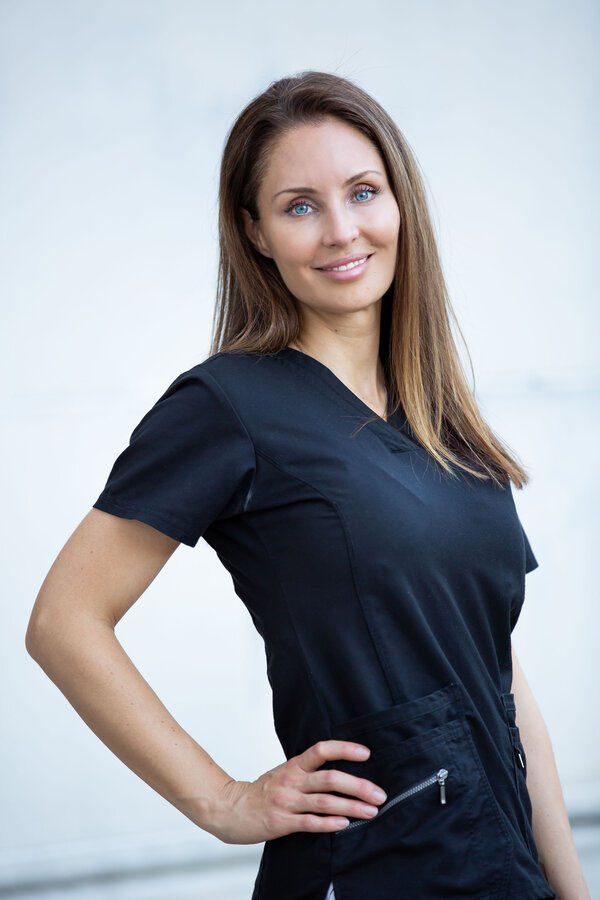
Dr. Ania Gawel, MD
Meet Dr. Gawel. Dr. Gawel is a highly experienced anesthesiologist who is board-certified in both Anesthesiology and Pediatric Anesthesiology, with fellowship training in pediatric anesthesiology from Cincinnati Children's Hospital. She earned her medical degree from Creighton University School of Medicine and completed her residency at UT Southwestern Medical Center, and has been in clinical practice since 2011, with particular expertise in pediatric cases. (Full bio on our Meet Our Team page.) Recovery afterward is handled by staff specifically trained in pediatric care.
For healthy children who are good candidates, this is a safe, reassuring setting; if your child would be safer having surgery in a hospital, Dr. Fewins will tell you and help arrange it.
An experienced surgeon — and a lower-cost setting
Dr. Fewins performs many of these procedures at a local ambulatory surgery center when that setting is appropriate for the child. In our practice experience, we commonly see families paying less than half—and sometimes close to one-third—of the hospital outpatient cost for the same planned procedure. This is not a guarantee: actual surgeon, anesthesia and facility charges depend on the procedure, insurance network, deductible and benefits.
Ask for a complete estimate before scheduling. If your child needs hospital resources or additional monitoring, the hospital is the appropriate setting regardless of cost.
You may request care with Dr. Fewins. Referral, authorization and network requirements depend on your insurance plan; our team can help you check before scheduling.
What recovery looks like
Most children go home the same day. The first week centers on staying hydrated, cool and soft foods, and steady pain control — Dr. Fewins and his team give you a clear plan and are reachable if you have questions. Most kids are back to school and normal activity within one to two weeks.
Frequently asked questions
Does my child really need their tonsils out?
Not always. Surgery makes the most sense for repeated infections or for breathing and sleep problems caused by large tonsils or adenoids. Dr. Fewins will give you a straight answer, including when it's reasonable to wait.
How is Dr. Fewins's approach different?
He uses Coblation and thermal welding — techniques chosen to reduce pain and bleeding and speed recovery — paired with Dr. Ania Gawel, a dedicated pediatric anesthesiologist who stays with your child the entire procedure, and pediatric-trained recovery staff.
Is the surgery safe for my child?
For healthy children who are good candidates, yes — with careful patient selection, a dedicated pediatric anesthesiologist, and pediatric recovery staff. Children with severe sleep apnea or other risks are better cared for in a hospital, and Dr. Fewins will refer them there.
How much school will my child miss?
Usually about one to two weeks, depending on the child and the procedure.
Is it covered by insurance?
Tonsil and adenoid surgery is typically covered when medically indicated. Coverage and out-of-pocket cost vary by plan — our office can help you check and get an estimate.
Who gives my child anesthesia?
Dr. Ania Gawel, MD, a physician anesthesiologist board-certified in both Anesthesiology and Pediatric Anesthesiology, personally provides the anesthetic from start to finish. She remains assigned to your child and does not simultaneously supervise another operating room.
Dr. John L. Fewins, MD, FACS is a board-certified otolaryngologist who cares for children in Fort Worth. Individual results and recovery vary.